
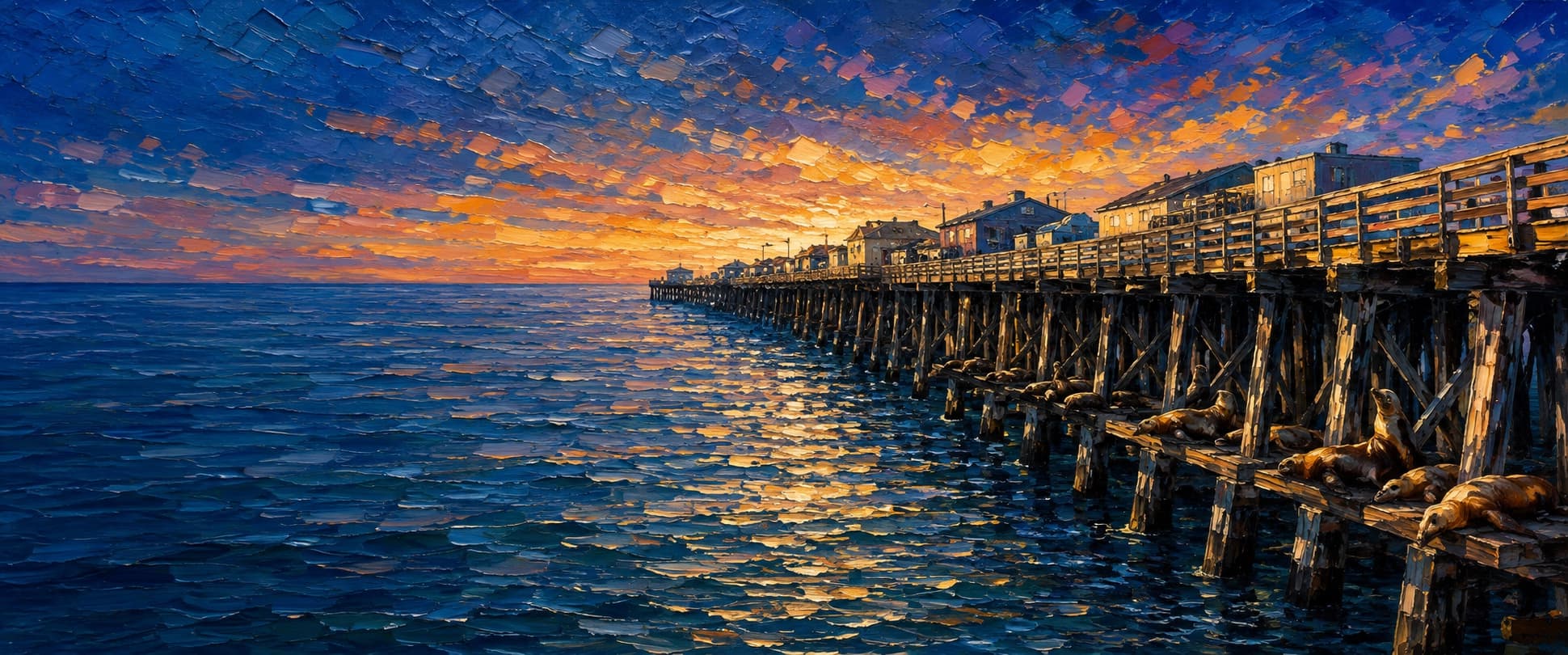
Santa Cruz Wharf (Santa Cruz Municipal Wharf)
Santa Cruz, California

Fishing conditions
Loading…
National Weather Service (api.weather.gov)
Loading…
NOAA CO-OPS predictions, station 9413745
- Sunrise—
- Sunset—
Dawn/dusk and a moving tide (the hour around a high or low) typically bring the most active bite — worth timing a trip around whichever falls closest to first/last light.
Loading…
Loading buoy telemetry…
NOAA National Data Buoy Center
Long wooden municipal wharf with a driveable commercial deck, fish market and restaurants along the middle reaches, boat-rental and public-landing activity on the east/Boardwalk side, and a widened outer end used heavily by anglers. The City describes it as stretching over half a mile into Monterey Bay National Marine Sanctuary. After a December 23, 2024 high-surf event caused a partial collapse at the wharf end, the City launched a 2025-26 interim repair project while keeping normal public use open during construction.
Species & regulations
Live anchovy, sardine, small mackerel, or other legal live bait fished near bottom around the mid-wharf rails or outer end, where the local report says halibut regularly use bait-rich water.
Sabiki-style bait rigs or small bait strips when schools move through; the local report specifically notes Pacific mackerel and jack mackerel as common live-bait and bucket-filling targets.
Sand crabs, worms, or mussel pieces near the inshore surf edge and along piling-adjacent water.
Small bottom baits in the mid-wharf sandy zone where local reporting says they are common.
⚠ No Santa Cruz Wharf-specific OEHHA advisory was found in the reviewed sources. Follow OEHHA's statewide advisory for California coastal locations without site-specific advice before keeping fish from here.
Heavier bottom rigs with cut bait at the inshore edge or outer end after surf settles; the local report notes occasional small sharks from the wharf.
Only a situational outer-end target where the wharf's artificial-reef effect attracts rock-oriented fish; use legal larger baits close to structure.
Bag/size limits sourced from CDFW's ocean sport fishing regulations — always double-check the current CDFW regs before keeping fish, as rules change.
Moon tracker
Recommended spots
- Outer-end perimeter
 Deepest accessible water / artificial-reef effect
The report describes the end as deeper sand-and-mud bottom with long-accumulated debris that now fishes like an artificial reef, producing halibut, larger perch, rock-oriented species, rays, and sharks. This is the clearest high-upside section on the wharf.
- Mid-wharf east rail

 Mid-depth rail / live-bait water
Pier Fishing in California says the east side is the main fishing side through the widened mid-wharf zone and that baitfish, white croaker, surfperch, sanddabs, sole, and halibut all show here. Good balance of access and fish variety when the end is crowded.
- Fishing wells over piling structureVertical piling structure
The wharf's fishing wells let anglers fish straight down among the pilings where the report documents mussels, barnacles, anemones, shrimp, and other growth. Strong structure spot, but noisy and prone to wildlife interference.
- Inshore surf edge off Main BeachShallow surf / breaker edge
The local wharf report describes shallow sandy water near Main Beach producing barred and calico surfperch most of the year, with occasional skates, flounder, and small sharks. Productive, but also the most foot-traffic-heavy section.
Landmarks
- Municipal Wharf entrance
 access
Shoreward entrance to the public drive-on wharf near Main Beach and the Boardwalk side of Cowell Beach.
- Stagnaro Brothers Sea Food / Fish Market
 amenity
Named OSM business node near the inshore portion of the wharf; useful orientation point at the crowded shoreward end.
- Stagnaro charters / boarding zoneamenity
Named OSM attraction node matching the mid-wharf commercial/boarding area described in local fishing reporting.
- Santa Cruz Boat Rentals / public landing sideaccess
The City says Santa Cruz Boat Rentals at 15 Municipal Wharf offers skiff rentals, bait and tackle, and that the seasonal public boat landing is across from it on the Boardwalk side.
- Lower-ledger sea lion zone
 hazard
The City's wildlife page says California sea lions are often found on the wharf's lower ledgers and floating docks; relevant for line tangles, bait theft, and crowding near the fishing wells.
- Outer wharf end / repair area
 structure
Generalized outer-end position from the OSM wharf polygon. The City documented 2025-26 interim repairs here after the December 2024 partial collapse.
Vegetation / growth assessment
The strongest documented habitat signal here is not a mapped kelp canopy under the deck but heavy piling biofouling. Pier Fishing in California describes most pilings as carrying mussels, barnacles, anemones, sponges, tunicates, crabs, and shrimp, while also describing sandy inshore and mid-wharf bottom and sand/mud at the end. The City recreation page separately notes nearby kelp beds off Cowell Cove for kayak tours, but that does not by itself prove a persistent wharf-edge canopy. These zones therefore map piling-growth intensity and keep any direct kelp claim conservative.
Piers grow algae, mussels, and barnacles on their pilings and along the deck edges over time — that build-up is what this section tracks. The more growth in a stretch, the easier it is for your hook, sinker, or line to catch on it and get stuck, which is one of the most common ways beginners lose tackle. Heavier growth isn't a reason to avoid a spot — it often holds bait and structure fish like — just expect to snag more and re-tie more often there.
The heaviest growth on Santa Cruz Wharf (Santa Cruz Municipal Wharf) is on the outer end — expect the most snags there, so budget a few extra rigs.
- Left flank · lightsome growth, light snag risk
Shallow breaker-zone pilings still provide structure, but the report emphasizes sandy surf habitat here more than dense growth.
- Left flank · moderatemoderate growth, expect occasional snags
General piling-biofouling zone derived from the report's repeated emphasis on organism-covered pilings along the wharf.
- Right flank · moderatemoderate growth, expect occasional snags
Same documented piling growth on the Boardwalk/east side, where the report also places much of the active fishing access.
- Outer end · heavyheavy growth, high snag risk — bring extra rigs
The end combines piling growth with deeper water and long-accumulated submerged debris, making it the most complex fish-holding zone described in the sources.

Reference sources
- CDFW Groundfish Regulations Summary — shore-based angler season/depth exemption
- OpenStreetMap Nominatim — Santa Cruz Municipal Wharf
- NOAA CO-OPS station 9413745 — Santa Cruz, Monterey Bay
- City of Santa Cruz — Santa Cruz Wharf
- City of Santa Cruz — Santa Cruz Wharf Recreation
- City of Santa Cruz — Santa Cruz Wharf Wildlife
- City of Santa Cruz — Wharf End Interim Repair Project (2025)
- Pier Fishing in California — Santa Cruz Wharf
- CDFW — Current California Ocean Recreational Fishing Regulations, Central Region
- CDFW — General Ocean Fishing Regulations
- CDFW — Summary of Recreational Groundfish Fishing Regulations
- CDFW — Sport Fishing Licenses and Report Cards
- OEHHA — Fish Advisories